Stop Promoting Random Affiliate Products
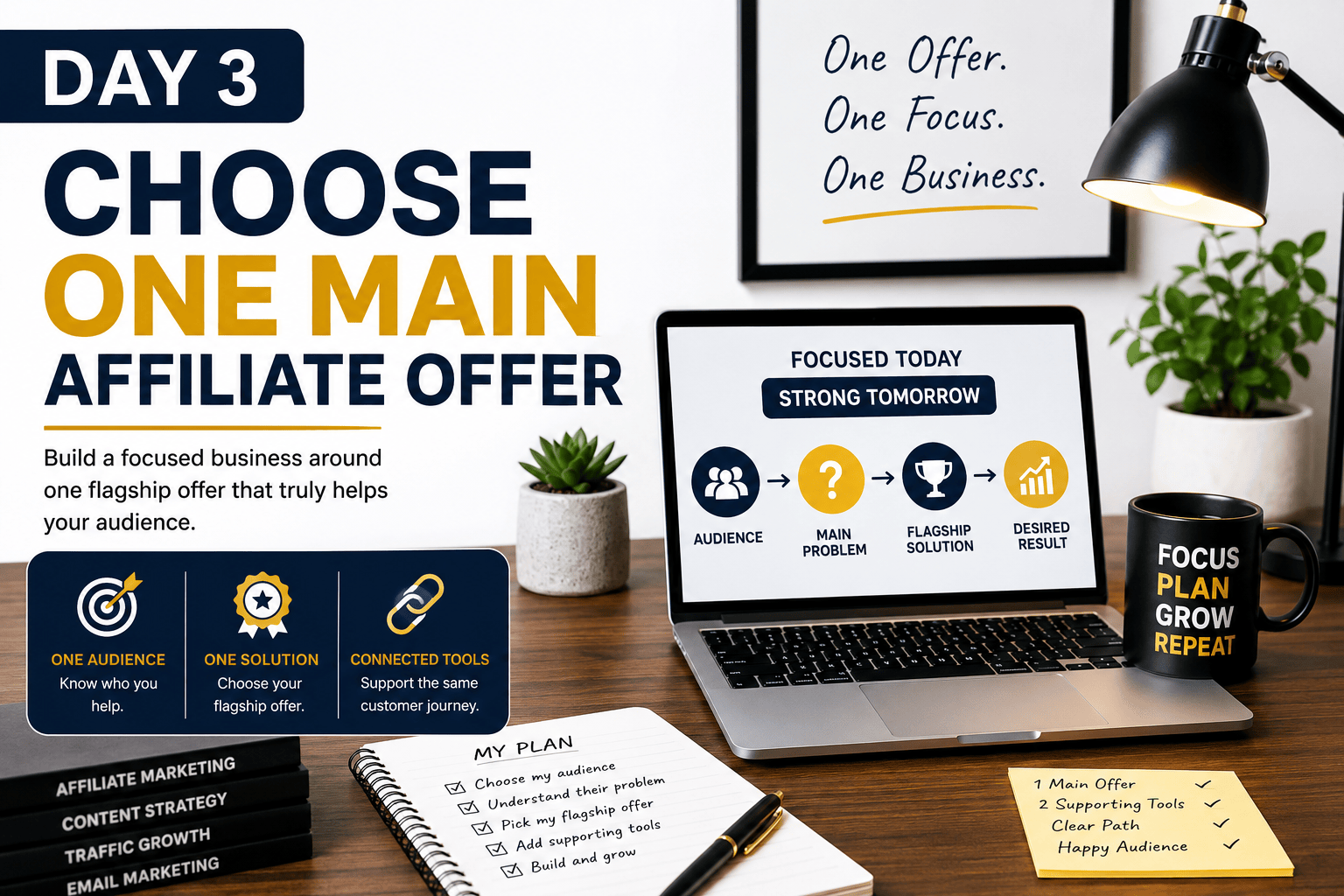
Welcome to Day 3 of the 7-Day Email Affiliate Bootcamp.
On Day 1, you chose a specific audience with a painful buying problem.
Today, you are going to choose the product that will sit at the centre of your affiliate marketing business.
This is one of the most important decisions you will make.
Many beginners believe that the fastest way to earn more money is to join as many affiliate programs as possible.
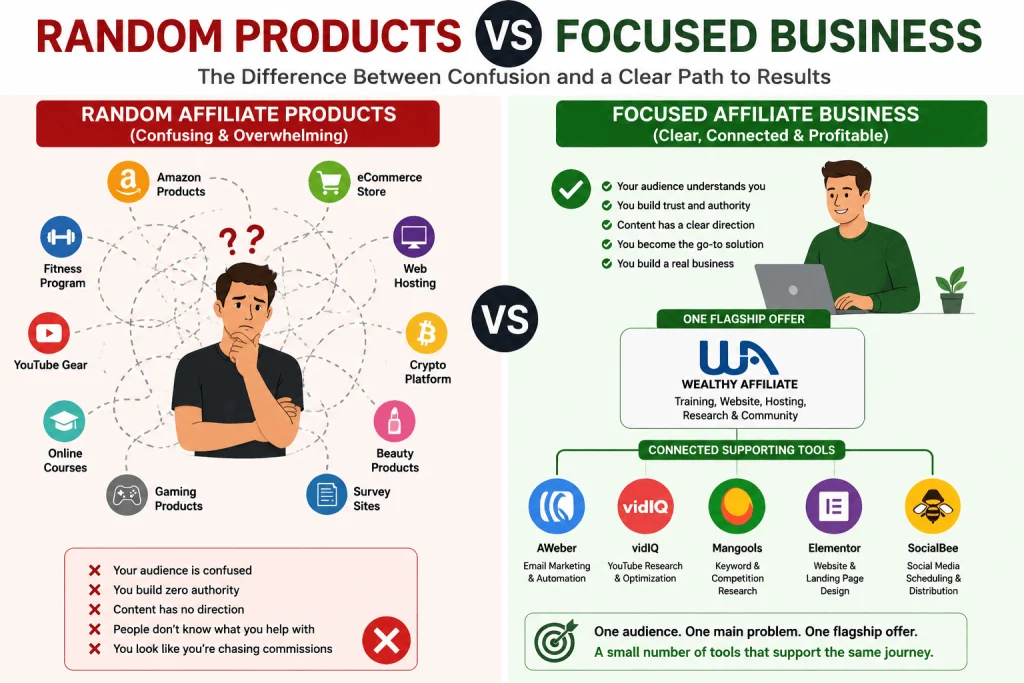
They collect affiliate links from Amazon, ClickBank, software companies, online courses, hosting companies, survey websites, cryptocurrency platforms, and anything else that promises a commission.
They then place all those links on their website, YouTube channel, or social media pages.
But instead of making more money, they create a confusing business.
Their audience cannot understand what they are known for.
Their content jumps from one topic to another.
One day they promote website hosting.
The next day they promote a weight-loss product.
After that, they promote a cryptocurrency platform or an online course.
This is not a focused affiliate business.
It is a collection of random links.
Your goal today is to avoid that mistake by choosing one main affiliate offer.
What Is a Main Affiliate Offer?
Your main affiliate offer is the primary product you recommend to help your audience solve its central problem.
It is sometimes called a:
- Flagship offer
- Core offer
- Primary recommendation
- Main solution
The name is not important.
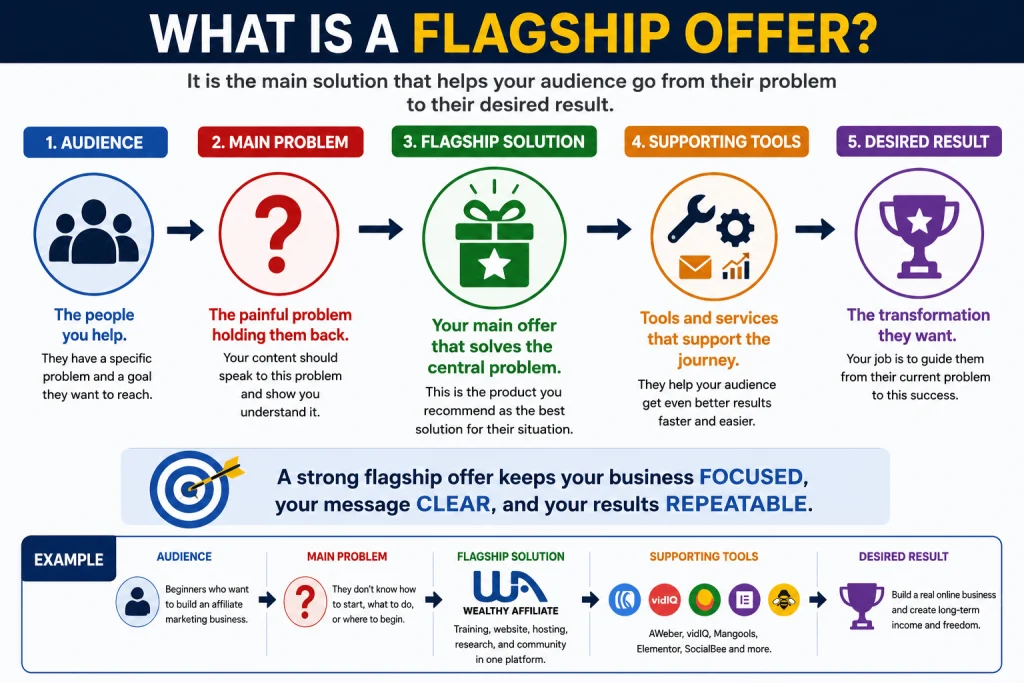
What matters is that the product connects directly to the main result your audience wants.
For example, imagine your chosen audience is:
Beginners who want to build an affiliate marketing business using free traffic.
Their main problem might be:
They don’t know how to choose a niche, build a website, create useful content, or find affiliate programs.
Their desired result is:
To build a real affiliate marketing business that can generate income over time.
Your main offer should help them move from their current problem towards that desired result.
For this audience, my flagship recommendation is Wealthy Affiliate.
Wealthy Affiliate is not simply another link that I add to a list of products.
It is the main business-building solution around which the rest of my recommendations are organised.
It is an official platform that currently combines affiliate marketing training, website building, WordPress hosting, market and keyword research, content tools, and community support.
That collection of tools addresses several of the biggest problems a beginner faces when starting an affiliate marketing business.
However, choosing Wealthy Affiliate as the flagship offer does not mean that it provides every tool a person will ever need.
That is where supporting products come in.
Your Business Is Not an Affiliate Product Supermarket
Imagine walking into a shop because you want help starting a vegetable garden.
The salesperson shows you:
- A laptop
- A fitness program
- A cryptocurrency course
- A kitchen blender
- A website builder
- A lawnmower
- A language-learning application
Some of those products may be good.
But they do not create a clear path for someone who wants to grow vegetables.
The customer will probably leave confused.
This is what happens when an affiliate marketer promotes unrelated products.
A focused affiliate business should feel more like visiting a specialist.
The specialist understands one type of customer, one major problem, and the steps needed to solve it.
For example:
“I help complete beginners build an affiliate marketing business using content and free traffic.”
Every product promoted by that business should support this promise.
The flagship product helps the customer achieve the main transformation.
Supporting products help the customer complete specific parts of the journey.
Why Promoting Random Products Usually Fails
1. Your audience becomes confused
People should be able to visit your website or channel and quickly understand what you help them do.
When your recommendations are unrelated, visitors do not know why they should follow you.
A person may discover you through a video about starting a blog.
But when they visit your channel, they find videos about survey applications, cryptocurrency, weight loss, gaming, and remote jobs.
There is no clear reason for that person to subscribe.
2. You struggle to build authority
Authority develops when you repeatedly help the same type of person solve connected problems.
The more focused your content becomes, the easier it is for people to see you as a useful guide.
You do not need to know everything.
You need to become helpful in one particular area.
3. Your content has no direction
When you promote random products, you constantly ask:
“What should I post today?”
When you have one audience and one flagship offer, content ideas become easier.
You can create content about:
- The problems your audience experiences
- The mistakes they make
- The questions they ask
- The products they compare
- The steps they need to follow
- The results they want
- The fears stopping them
- The tools that can help them
Your main offer gives your content a direction.
4. You appear to be chasing commissions
People can tell when someone recommends a product only because it pays a high commission.
A high commission does not automatically make a product good.
A low commission does not automatically make a product bad.
Your audience cares about whether the product can help them.
Trust is more valuable than one quick commission.
5. You make the buying decision more difficult
When you recommend 10 products for the same problem, the customer must compare all 10.
That creates confusion.
Confused customers usually delay making a decision.
Your job is not to show people every possible product on the internet.
Your job is to research the available options and help them make a better decision.
The Flagship Offer and Supporting-Tool Model
Think of your affiliate business as a journey.
Your customer starts at Point A with a problem.
They want to reach Point B, where the problem is solved, or their situation has improved.
Your flagship offer should help them complete most of that journey.
Supporting tools should help them overcome smaller problems along the way.
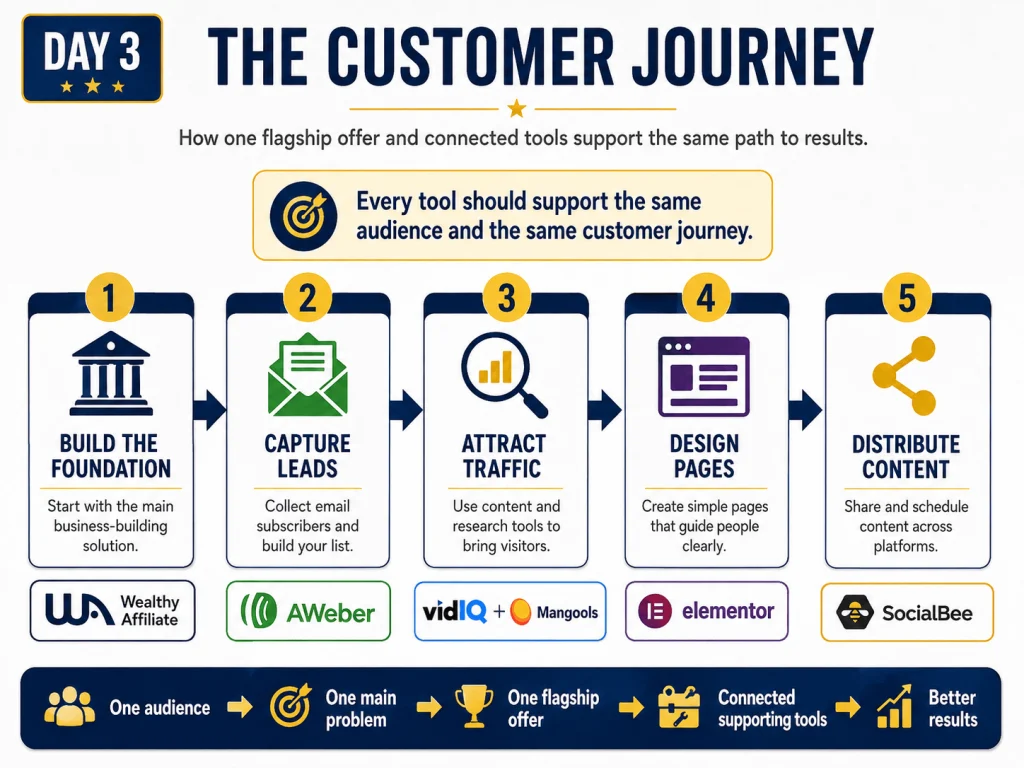
For this bootcamp, the customer journey could look like this:
Build the business foundation → Capture potential customers → Attract traffic → Improve presentation → Distribute content
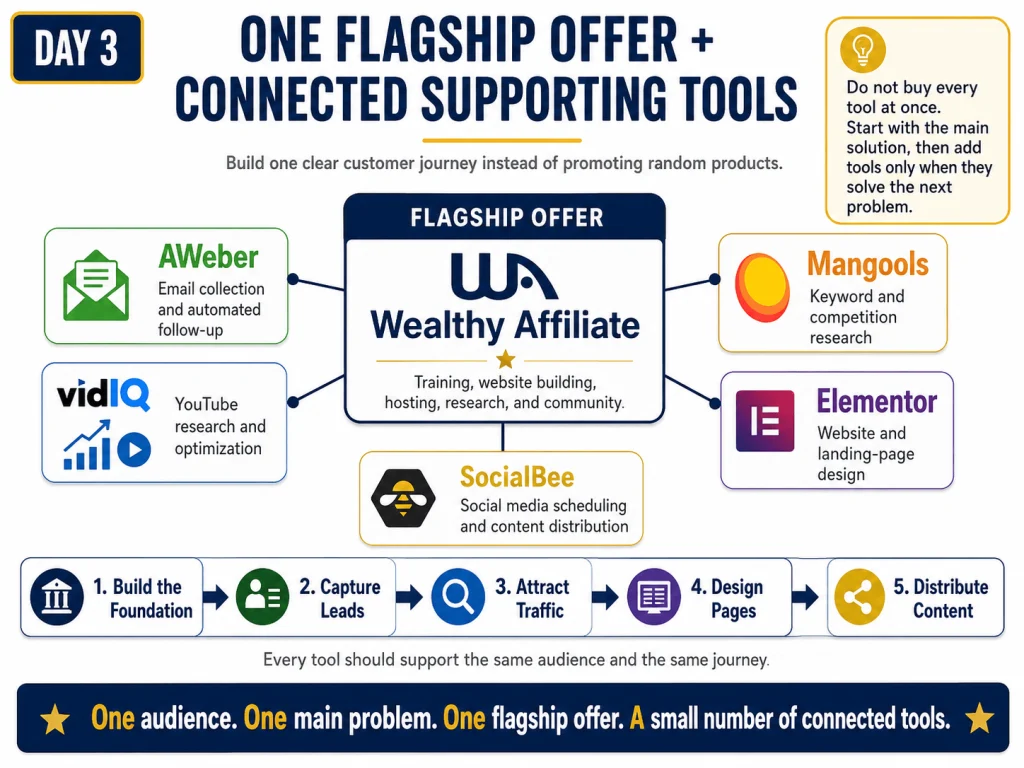
Here is how the tools fit into that journey:
- Wealthy Affiliate: Build the business foundation
Wealthy Affiliate is the flagship offer.
It helps beginners learn affiliate marketing, choose a direction, research topics, build a WordPress website, publish content, and get support.
- AWeber: Capture and follow up with potential customers
AWeber supports the email marketing part of the business.
It provides email marketing, sign-up forms, landing pages, subscriber management, and automated campaigns.
- vidIQ: Attract traffic through YouTube
vidIQ supports students who choose YouTube as a main traffic source.
Its tools help creators research YouTube keywords, examine search volume and competition, find content opportunities, and improve elements such as titles and descriptions.
- Mangools: Attract traffic through Google
Mangools supports students who want to attract visitors through blogging and search engine optimisation.
Its toolkit includes keyword research, search-results analysis, rank tracking, backlink analysis, and competitor research.
- Elementor: Improve website and landing-page design
Elementor is a visual WordPress page builder.
It lets website owners design pages and landing pages with a drag-and-drop editor instead of building every page from scratch.
- SocialBee: Schedule and distribute content
SocialBee can help a business schedule and distribute content across platforms such as Facebook, Instagram, LinkedIn, Pinterest, TikTok, YouTube, Threads, and X.
Do you see the difference?
These products are not being promoted randomly.
Each product has a particular job.
They all support the same customer journey.
Why Wealthy Affiliate Is My Flagship Recommendation
I have been a member of Wealthy Affiliate since 2018.
That experience has allowed me to study the platform, its training, tools, community, and business model.
I recommend it as the flagship product for this bootcamp because it brings several important parts of building an affiliate business into one platform.
A complete beginner normally needs to learn how to:
- Choose a direction
- Understand affiliate marketing
- Research keywords and topics
- Build a website
- Create helpful content
- Attract visitors
- Find products to promote
- Track progress
- Get help when confused
Instead of trying to collect separate services for every one of these activities on the first day, a beginner can start with a platform that provides a central foundation.
But I also want to be honest about what Wealthy Affiliate cannot do.
It cannot guarantee that you will make money.
It cannot create a successful business while you do nothing.
It cannot force people to read your articles, watch your videos, or join your email list.
It does not replace the need to practise, research, publish content, and improve your skills.
You may also need specialised tools outside the platform as your business grows.
For example, you will still need a dedicated email marketing service if you want to build an email list and send automated follow-up emails.
Wealthy Affiliate may not be suitable for someone looking for guaranteed income, instant money, or a job with a fixed salary.
It is better suited to someone who wants to learn how to build an online business and is willing to work consistently.
That is an important distinction.
A trustworthy recommendation should explain both who the product is for and who it is not for.
Do Not Purchase Every Supporting Tool Today
Seeing a list of useful tools can create a new problem.
You may feel that you need to purchase everything before you begin.
You do not.
Tools do not create a business by themselves.
A beginner with 6 paid tools and no content is in a weaker position than a beginner with one useful platform and 10 helpful pieces of content.
Start with the tool that helps you solve your most important current problem.
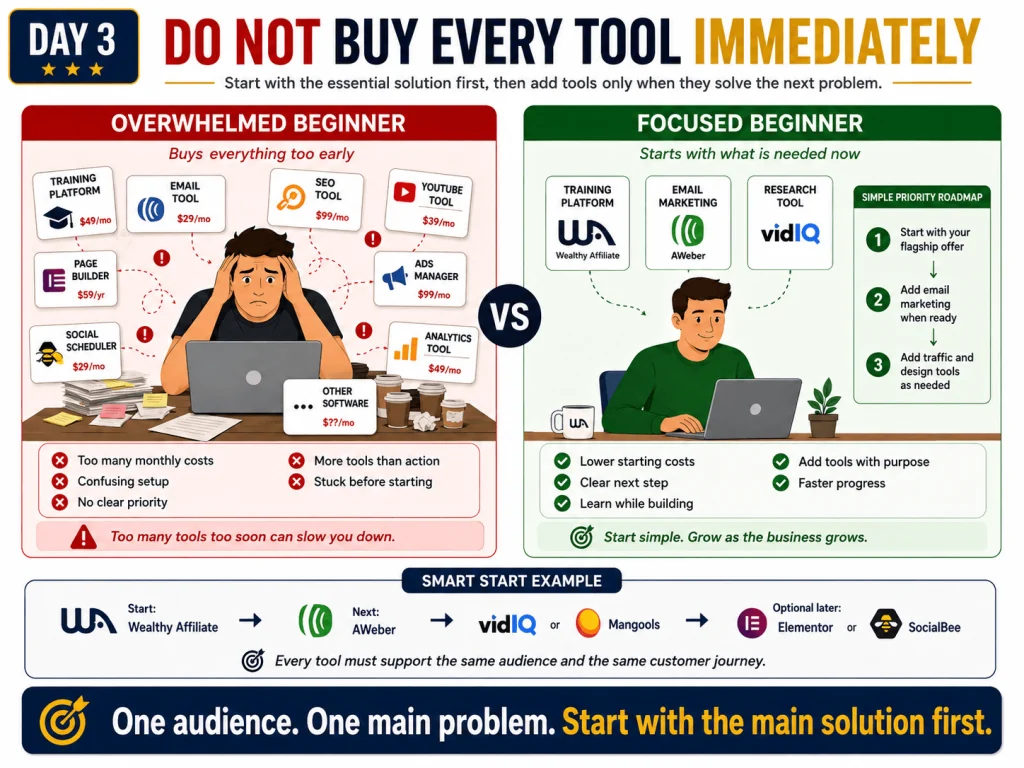
A simple starting stack might be:
For a beginner using YouTube
- Flagship: Wealthy Affiliate
- Email marketing: AWeber
- Traffic research: vidIQ
For a beginner using blogging and Google
- Flagship: Wealthy Affiliate
- Email marketing: AWeber
- Additional SEO research: Mangools
For someone who is not ready to build an email list
- Flagship: Wealthy Affiliate
- Use available free research methods
- Add AWeber when you are ready to collect subscribers
Mangools may also overlap with keyword-research features already available through Wealthy Affiliate.
It should therefore be introduced when a student needs additional SEO analysis, not simply because it offers an affiliate commission.
The rule is simple:
Add a tool because the customer has reached a new problem, not because you have found a new affiliate program.
How to Judge an Affiliate Program
Never choose an affiliate program by looking only at the commission percentage.
A program offering a 70% commission can still be a bad choice.
The product may be poor.
The refund rate may be high.
The company may provide weak support.
The tracking may be unreliable.
The price may be unreasonable for your audience.
Use the following factors before making a product your flagship recommendation.
1. Does the product solve the central problem?
Return to the niche statement you created on Day 1.
What is the main problem your audience wants to solve?
The product should move the customer closer to the desired result.
For example, an affiliate marketing training platform makes sense for someone who wants to build an affiliate business.
A social media scheduler does not solve the whole problem.
It only helps with content distribution.
That makes the scheduler a supporting tool, not the flagship offer.
2. Is the product suitable for your audience?
A product can be excellent but wrong for your particular audience.
Ask:
- Is it beginner-friendly?
- Is it available in the countries I target?
- Can my audience reasonably afford it?
- Does it require technical experience?
- Does it solve the problem my content discusses?
- Is it suitable for the traffic method I teach?
Do not recommend an expensive advanced tool to beginners who have not yet created their first piece of content.
3. Is the product genuinely useful?
Look beyond the affiliate sales page.
Study what the customer actually receives.
Check:
- The training or features
- The quality of the service
- How frequently it is updated
- Whether the product works as advertised
- Whether important features require expensive upgrades
- Whether there are hidden costs
Whenever possible, use the product yourself.
When you cannot purchase or test it fully, be transparent.
Explain that your analysis is based on demonstrations, official information, public reviews, customer experiences, and independent research.
Never pretend to have used something you have not used.
4. What is the company’s reputation?
Search for recent information about the company.
Do not rely only on testimonials shown on the company’s website.
Look at:
- Independent reviews
- YouTube comments
- Reddit discussions
- Customer complaints
- App-store reviews
- Social media comments
- Refund complaints
- Support complaints
- Reports of tracking or payout problems
Pay attention to dates.
A complaint from seven years ago may no longer describe the current product.
At the same time, a company with many recent unresolved complaints should be investigated carefully.
Do not judge the company using one positive or negative review.
Look for repeated patterns.
5. Is the price reasonable?
Ask whether the customer receives enough value for the total cost.
Do not look only at the starting price.
Check whether the customer will also need to pay for:
- Hosting
- Email marketing
- Templates
- Advertising
- Additional training
- Premium features
- Transaction fees
- Required software
- Upgrades
- Renewal charges
A cheap product can become expensive when essential features are locked behind upgrades.
An expensive product can still offer good value if it replaces several other tools and provides strong support.
Your responsibility is to explain the complete cost as clearly as possible.
6. Is customer support available?
Good support becomes extremely important when you recommend products to beginners.
Check:
- How customers contact support
- Whether live chat is available
- Typical response times
- Whether support is available in multiple countries
- Whether there is useful documentation
- Whether account and payment problems are handled properly
Remember that your audience may contact you when something goes wrong.
You are not the company’s customer-service department, but your reputation can still be affected by the products you recommend.
7. Is the refund policy clear?
Read the refund policy before promoting the product.
Check:
- How many days customers have to request a refund
- Whether all purchases qualify
- Whether subscriptions and renewals are treated differently
- Whether there are non-refundable charges
- How the customer submits the request
- How long the refund process takes
Do not promise a refund unless the official policy clearly supports your statement.
Policies can change, so encourage customers to read the current terms before purchasing.
8. Is the tracking reliable and understandable?
Affiliate programs use tracking systems to connect a customer’s click or purchase to the correct affiliate.
Many programs use cookies or similar attribution technology.
A cookie window determines how long a referral may remain connected to the affiliate after the initial click.
Before joining a program, investigate:
- The cookie or attribution period
- Whether tracking works across devices
- Whether discount codes affect attribution
- Whether you receive a reporting dashboard
- How quickly clicks and sales appear
- What happens when a customer receives a refund
- Whether cancelled purchases reverse commissions
- Who receives credit when several affiliates refer the same customer
No tracking system is perfect.
You should understand the rules before building your entire business around a program.
9. Is the commission structure worthwhile?
Check more than the advertised commission rate.
Ask:
- Is the commission one-time or recurring?
- Is it based on the full purchase price?
- Are commissions reduced by discounts?
- Is there a minimum payout amount?
- How frequently are affiliates paid?
- Which payment methods are available?
- Are there holding periods?
- What happens if the customer cancels?
- Can the company change the commission rate?
- Are commissions available for renewals?
A recurring commission can be attractive, but only when customers continue receiving value and remain subscribed.
Do not promote a poor subscription simply because it offers recurring payments.
10. Can you promote it honestly?
Read the affiliate agreement.
Some programs do not allow:
- Paid advertising using the company’s brand name
- Misleading income claims
- Spam
- Self-referrals
- Coupon advertising
- Unapproved promotional materials
- Certain traffic sources
- False product comparisons
You must also disclose your affiliate relationship clearly.
For example:
Disclosure: Some links in this lesson are affiliate links. If you purchase through one of these links, I may earn a commission at no additional cost to you. I only recommend products that I believe may help you build your online business.
The U.S. Federal Trade Commission advises creators to place disclosures with the endorsement itself and make the relationship clear rather than hiding it among links or hashtags.
Other countries may have their own advertising and consumer-protection requirements.
Honest disclosure does not weaken your recommendation.
It builds trust.
The Flagship Offer Scorecard
Use this simple scorecard before making a product your main recommendation.
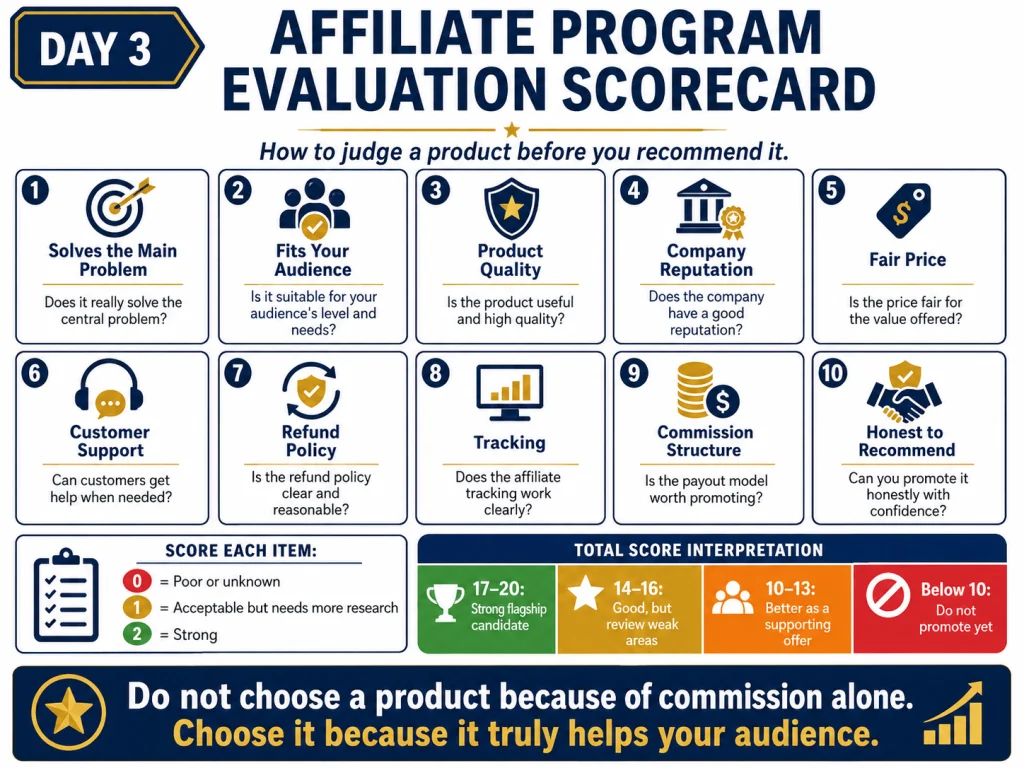
Give the product:
- 0 points: Poor or unknown
- 1 point: Acceptable but needs more investigation
- 2 points: Strong
Score the product on these ten questions:
- Does it solve the audience’s main problem?
- Is it suitable for the audience’s experience level?
- Is the product useful and good quality?
- Does the company have a reasonable reputation?
- Does the price provide fair value?
- Is customer support available?
- Is the refund policy clear?
- Is the tracking system explained?
- Is the commission structure worthwhile?
- Can you recommend it honestly?
The maximum score is 20.
Use this basic interpretation:
- 17–20: Strong flagship candidate
- 14–16: Possible candidate, but investigate the weak areas
- 10–13: Better as a supporting offer or not ready for promotion
- Below 10: Do not promote it until the serious concerns are resolved
This score does not guarantee that a program is good.
It forces you to slow down and think before recommending it.
Your Day 3 Assignment
By the end of today, you should have one flagship offer and a small number of connected supporting tools.
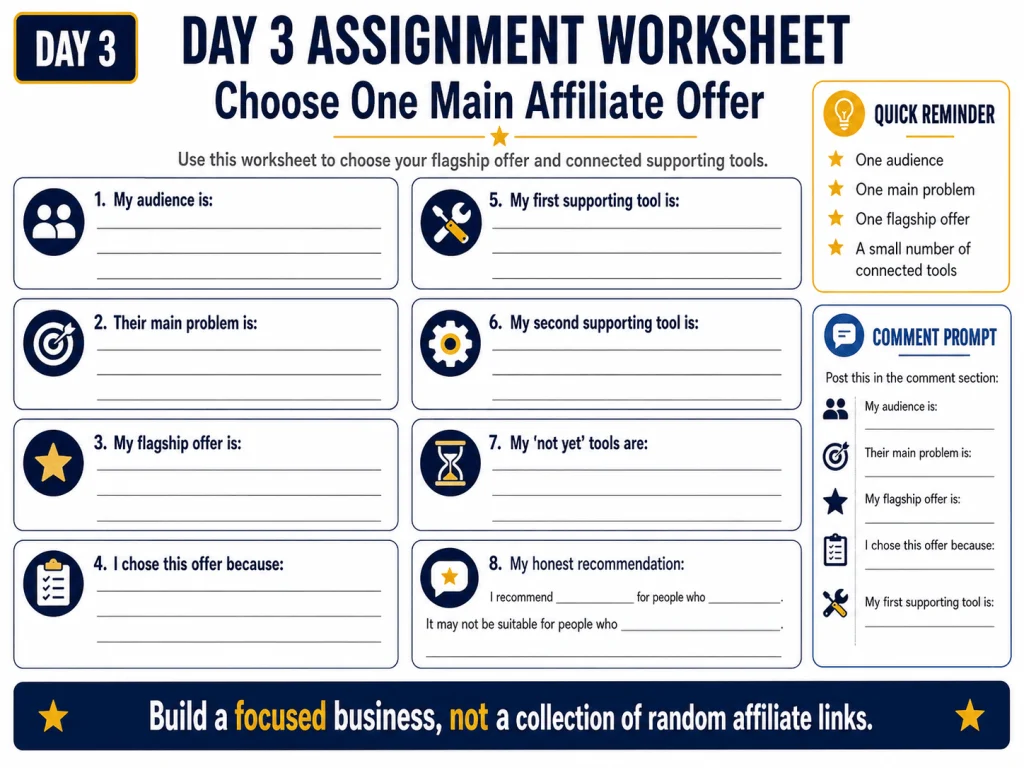
Step 1: Write your audience statement
Complete this sentence:
I help __________ who are struggling with __________ achieve __________.
Example:
I help complete beginners who are struggling to start affiliate marketing build a focused online business using content and free traffic.
Step 2: Choose the flagship offer
Complete this sentence:
My flagship offer is __________ because it helps my audience __________.
Example:
My flagship offer is Wealthy Affiliate because it helps beginners learn affiliate marketing, research their business idea, build a website and start creating content from one central platform.
Step 3: Choose no more than two immediate supporting tools
Complete this section:
My first supporting tool is __________. It helps the customer __________.
My second supporting tool is __________. It helps the customer __________.
Example:
My first supporting tool is AWeber. It helps the customer collect email subscribers and send automated follow-up messages.
My second supporting tool is vidIQ. It helps customers using YouTube research topics and improve their videos.
You do not need to choose every tool today.
Step 4: Create a “not yet” list
Write down the products that may be useful later but are not currently necessary.
Example:
- Elementor: Add when I need more advanced page design
- SocialBee: Add when I have enough content to schedule regularly
- Mangools: Add when I need deeper Google keyword and competitor research
This list protects you from unnecessary monthly expenses.
Step 5: Write your honest recommendation
Complete this statement:
I recommend __________ for people who __________. It may not be suitable for people who __________.
Example:
I recommend Wealthy Affiliate for beginners who want training, website tools, research and community support while building an affiliate marketing business. It may not be suitable for someone looking for guaranteed income, instant results or a fixed monthly salary.
This type of recommendation is more trustworthy than saying:
“This product is perfect for everyone.”
No product is perfect for everyone.
Your Day 3 Comment Question
Post your answer in the comment section using this format:
My audience is:
Their main problem is:
My flagship offer is:
I chose this offer because:
My first supporting tool is:
Do not worry if your answer is not perfect.
The purpose of posting it is to help you think clearly and receive feedback before building more content around the wrong product.
Also read at least one other student’s answer.
Ask yourself whether their flagship offer clearly connects to the audience’s main problem.
You may notice something they missed, and they may notice something you missed.
Day 3 Result
By completing today’s lesson, you should now have:
- One clearly defined audience
- One central buying problem
- One flagship affiliate offer
- One or two immediate supporting tools
- A list of tools you may add later
- A clear reason for every product you recommend
Your business should no longer look like a collection of random affiliate links.
It should look like a connected system.
The flagship offer solves the main problem.
The supporting tools help the customer complete the journey.
Remember this rule:
One audience. One central problem. One flagship offer. A small number of connected tools.
You can add more products later, but every new recommendation must earn its place in your business.
Do not ask:
“How much commission does this product pay?”
First ask:
“Will this genuinely help the people who trust me?”
When you protect your audience, you also protect the long-term future of your affiliate business.
In the next lesson, we will begin turning your chosen offer into a simple online business system instead of sending visitors directly to random affiliate links.

Franck Chanda is the founder of Affiluma and a content creator who investigates ways to make money online. Drawing on his experience in affiliate marketing since 2018, he reviews apps, websites, and online programs to help beginners understand what’s worth their time, what to avoid, and which alternatives to consider. My goal is simple: to give you clear explanations, honest opinions, and practical steps without the hype.